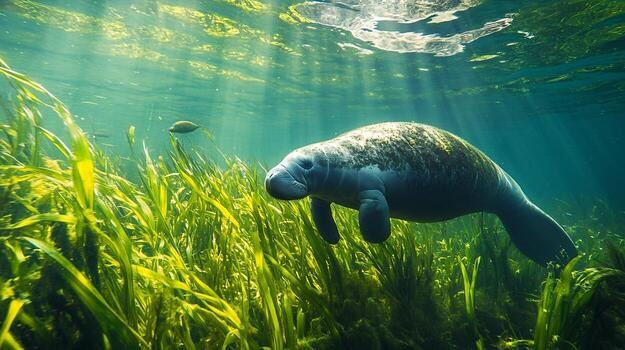
To support their livelihoods local communities, indigenous peoples and artisanal fishers often rely on coastal resources. Thomas Hickey from the Pew Charitable trusts says “if we don't protect the sea grasses, the food we eat, the climate that sustains us, the livelihoods and homes on the coastlines are all at risk”
Protecting coastal ecosystems
In the Western Indian Ocean, coastal communities—including youth and women—invest countless hours in conserving and restoring watersheds. Speaking at the WIO Seagrass and NDC webinar , Dr. Jaqueline Uku from Kenya Marine and Fisheries Research Institute referred to Seagrasses as the Savannah of the Indian Ocean.
While oceans absorb approximately one third of human made carbon dioxide emissions annually , sea grass meadows store intense amounts of blue carbon. They also serve to prevent coastal erosion, stabilize shorelines and detoxify coastal water. Coastal habitats also maintain biodiversity, drive nutrient cycling and act as a critical spawning and nursery grounds. Coastal ecosystems including mangroves, coral reefs, salt marshes, and sea grass meadows provide ecosystem services that maintain Earth’s Life support systems by managing natural cycles.
The ocean’s forgotten Middle Child
Sea grass ecosystems span 12000 kilometers of coastline in the Western Indian Ocean. They grow closely alongside coral reefs and mangrove forests. Every year, WIOMSA estimates a 7% annual loss of sea grass cover due to climate change, pollutants and over-fishing.There has been intensive ongoing efforts for coral reef restoration under community based restoration projects like REEL Kilifi, Mikoko Pamoja and the Lamu Blue Carbon projects for mangroves. “Out of sight, out of mind beneath the waters.” Lenice Ojwang from Flora and Fauna recounts. “I look at the sea grass like the middle child in a family. And it's so easy to focus on the firstborn mangroves and the darling lastborn corals and often we forget the critical role sea grass plays in linking the two ecosystems.” Not often seen much of the sea grass cover is silently lost. With little , almost non-existent data on sea grass in the WIO region it is difficult to estimate the extent of loss or inform restorative efforts.
Regional Collaboration and shared commitment
By facilitating regional efforts such as the Large Scale Sea Grass Mapping and Management Initiative ( LaSMMI) that work to build standardized field verified maps and carbon assessments across the region and Molecular monitoring, governments can implement effective restoration and conservation strategies that safeguard these critical ecosystems.
A project that started within Seychelles with a commitment of protecting 100 percent of its sea grass ecosystems, has now grown to a region wide project adopted across the Western Indian Ocean.
During the Nairobi Convention COP 12 in Daresalaam this October , the contracting Parties comprising 10 countries backed the decision to turn Commitment to action that protects ecosystems, strengthens livelihoods and builds resilience for coastal communities .H.E. Deogratius John Ndejembi, Vice President of the United Republic of Tanzania, in his speech during the opening of the high-level segment emphasised, “a sustainable blue economy must be good for people, good for nature, and good for the future of our region.”
In partnership with Pew charitable trusts , WIOMSA , University of SouthHampton,and local community led institutions, Ceanapse joins the collaborative effort, through the LaSMMI project in satellite mapping of sea grass habitats. Sea Grass conservation and restoration can be harnessed to build a sustainable blue economy, good for people, good nature, and good for the future of the region.